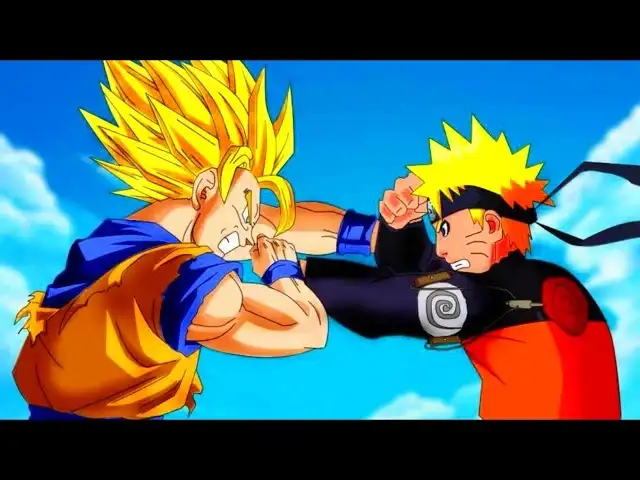
Welcome, fellow enthusiasts, to 'Who is best, Goku or Naruto?'—the ultimate arena where fictional titans clash, not just with their fists and jutsu, but with the very essence of their being. Few debates ignite the anime and manga community quite like the perennial question: Goku or Naruto? Is it the raw, universe-shattering power of the Saiyan warrior, Son Goku, that claims supremacy? Or the indomitable spirit and cunning strategy of the Seventh Hokage, Naruto Uzumaki? This isn't just a hypothetical brawl; it's a clash of ideologies, power scaling, and narrative philosophies that span decades of storytelling. Today, we're not merely seeking a victor in a one-on-one fight, but embarking on a comprehensive journey to understand the foundational elements that make both characters legends, dissecting their strengths, weaknesses, and the profound impact they’ve had on global pop culture.
The allure of this debate lies in its perceived simplicity contrasted with its actual complexity. On the surface, it’s a pure power comparison. Delve deeper, and you encounter universes with vastly different rules, protagonists driven by distinct motivations, and fanbases fiercely loyal to their chosen hero. Our exploration will transcend simple power levels, venturing into the narrative construction of each character, their growth arcs, their supporting casts, and the very fabric of the worlds they inhabit. By the end, while you might still hold your personal favorite aloft, you'll possess a richer understanding of why this debate persists and why both Goku and Naruto are indispensable pillars of the shonen genre.
The Saiyan Paragon: Son Goku's Journey of Power and Protection
Son Goku, the main protagonist of Akira Toriyama's seminal Dragon Ball series, is more than just a character; he is the archetypal shonen hero that set the standard for generations to come. His journey begins as a curious, naive boy with a monkey tail, possessing superhuman strength, and living in isolation. His innocence and pure heart are defining traits from the outset, contrasting sharply with his alien Saiyan heritage, a warrior race known for their destructive tendencies.
Origins and Evolution
Goku's origin story is steeped in legend. Sent to Earth as an infant to destroy its inhabitants, a head injury alters his programming, turning him into a kind-hearted protector. This early twist is crucial, as it establishes a core theme: destiny can be defied, and one's actions, not their birthright, define them. His early adventures with Bulma, Master Roshi, Krillin, and Yamcha are a masterclass in world-building, introducing elements of martial arts, fantasy, and sci-fi that would become hallmarks of the series.
His power progression is arguably the most iconic in manga history. From the early World Martial Arts Tournaments, where he battled foes like Piccolo, to facing cosmic threats like Vegeta, Frieza, Cell, and Buu, Goku's growth is exponential. Each new adversary pushes him beyond his limits, forcing him to unlock new transformations and techniques. The introduction of the Super Saiyan form during his battle with Frieza was a watershed moment, not just for the character but for the entire genre, establishing a visual language for power-ups that would be emulated countless times.
Defining Traits and Motivations
Goku's personality is deceptively simple: he loves to fight, eat, and protect his friends and family. However, these simple desires mask a profound martial arts philosophy. He doesn't seek power for dominance or conquest, but for the thrill of a challenge and the ability to safeguard those he cares about. His naiveté often leads to hilarious misunderstandings, but his unwavering moral compass and willingness to forgive even his most heinous enemies (like Vegeta and Piccolo) underscore his pure-hearted nature.
His primary motivation is self-improvement through battle. He constantly seeks stronger opponents, not out of malice, but out of a desire to push his own boundaries and reach new heights. This intrinsic drive is what propels him through numerous sagas, culminating in god-tier transformations like Super Saiyan God, Super Saiyan Blue, and the ultra-instinctual state of Ultra Instinct. Each form represents a new echelon of power, speed, and mastery over his own ki.
Key Battles and Legacy
From the epic clash with Frieza on Namek, which pushed Goku to become a Super Saiyan out of pure rage and grief, to his heart-stopping battle against Jiren in the Tournament of Power, showcasing the raw, unadulterated power of Ultra Instinct, Goku's battles are legendary. They are often characterized by explosive energy blasts, lightning-fast martial arts, and climactic beam struggles that leave landscapes devastated. These fights are not just spectacles; they are narrative vehicles for character development, revealing Goku's resilience, strategic thinking, and boundless potential.
Goku's legacy is undeniable. He popularized the 'power fantasy' in shonen manga, established the concept of definitive transformations, and showcased a hero who is strong yet relatable. He taught generations of fans about perseverance, the importance of training, and the joy of challenging oneself. His influence permeates nearly every battle-shonen series that followed, from character designs to plot structures.
The Unyielding Shinobi: Naruto Uzumaki's Path to Hokage
Across another vibrant and ninja-filled universe, we find Naruto Uzumaki, the loud, boisterous, and surprisingly profound protagonist of Masashi Kishimoto's Naruto. His journey is one of overcoming prejudice, forging bonds, and proving his worth in a world initially hostile to him.
Origins and Evolution
Naruto's story begins with profound loneliness and a tragic burden. An orphan and the jinchuriki of the Nine-Tailed Fox, Kurama, he is ostracized and feared by the villagers of Konohagakure. His early life is marked by pranks and a desperate yearning for recognition, encapsulated by his dream of becoming Hokage—the strongest ninja and leader of his village. This dream isn't just about power; it's about acceptance, respect, and belonging.
His growth, while different from Goku's raw power progression, is equally compelling. Naruto's initial struggles with even basic ninja techniques are a stark contrast to his later mastery. His development is characterized by perseverance, innovative application of jutsu, and the gradual understanding of his own inner power and the power of camaraderie. Techniques like the Rasengan, Shadow Clones, and Sage Mode are not just power-ups; they are reflections of his ingenuity and his willingness to learn from various mentors like Jiraiya and Killer B.
Defining Traits and Motivations
Naruto's 'never give up' motto, or 'Nindo,' is the cornerstone of his character. Despite facing constant rejection and overwhelming odds, he never wavers in his belief in himself and others. His unwavering optimism, empathy, and ability to befriend even his enemies (a concept often referred to as 'Talk no Jutsu') are unique strengths that often prove more potent than any physical attack.
His primary motivation is to protect his 'precious people' and achieve his dream of becoming Hokage, thereby earning the respect and love he craved. Unlike Goku, who fights for the challenge, Naruto fights for peace, understanding, and to create a world where no one experiences the same loneliness he did. This motivation fuels his most significant power-ups, such as mastering the Nine-Tails Chakra Mode and later the Six Paths Sage Mode, which merge his individual strength with the collective power of his allies and the inherent goodwill of Kurama.
Key Battles and Legacy
Naruto's battles are deeply personal and emotionally charged. His iconic fight against Gaara, where he understood and broke the cycle of hatred, solidified his resolve. His enduring rivalry with Sasuke Uchiha, a friend turned foe, is a core emotional anchor of the series, culminating in epic, heart-wrenching clashes that explore themes of friendship, vengeance, and destiny. His fight against Pain, where he single-handedly saved Konoha, transformed him from an outcast into a true hero, earning him the respect he had always desired.
Naruto's legacy is immense. He revitalized the ninja genre, introduced complex themes of war, prejudice, and reconciliation, and provided a relatable underdog story that resonated with millions. He taught fans about perseverance, the importance of friendship, and the power of empathy. His impact on shonen manga is evident in the character arcs and thematic explorations of countless series that followed.
The Clash of Titans: Power, Abilities, and Fighting Styles
Now, let's address the elephant in the room: who would win in a direct confrontation? This is where the debate becomes incredibly nuanced due to the vastly different power scales and rules governing their respective universes.
Physical Attributes: Strength, Speed, Durability
Goku, especially in his later forms (Super Saiyan Blue, Ultra Instinct), operates on a truly cosmic scale. He has demonstrated the ability to destroy planets with ease, shatter dimensions with his punches, and move at speeds far exceeding the speed of light, even crossing galaxies in short periods. His durability allows him to withstand planet-destroying attacks and even attacks from universe-level threats. His stamina, particularly in Ultra Instinct, is seemingly limitless for short bursts, and his Saiyan biology allows for rapid recovery and Zenkai boosts.
Naruto, at his peak (Six Paths Sage Mode), possesses immense physical strength, capable of destroying mountains and craters with single blows. His speed is exceptional, moving faster than the eye can track and reacting to light-speed attacks. His durability, amplified by Kurama's chakra and Sage Mode, allows him to survive devastating attacks that would obliterate lesser beings. However, even at his strongest, Naruto's destructive capacity and speed, while phenomenal within his own universe, rarely reach the cosmic levels demonstrated by Goku in Dragon Ball Super. The most powerful attacks in Naruto's universe are typically continental or planetary in scale, whereas Goku deals with universal threats.
Energy Attacks and Special Abilities
Goku's signature attack is the Kamehameha, a powerful energy wave that can obliterate foes and planets alike. He also utilizes various ki blasts, the Spirit Bomb (drawing energy from living beings), and instantaneous movement via Instant Transmission. His transformations are direct power multipliers, enhancing every aspect of his being to unimaginable levels. Ultra Instinct, in particular, grants him autonomous movement, allowing his body to react and dodge without conscious thought, making him an almost untouchable combatant.
Naruto's arsenal is diverse and tactical. His Rasengan, in its many variations (Rasenshuriken, Tailed Beast Rasengan), is a formidable, concentrated ball of chakra that can cause immense internal and external damage. His Shadow Clone Jutsu allows him to create hundreds or thousands of clones, overwhelming opponents, scouting, or practicing simultaneously. Sage Mode grants him enhanced physical abilities and access to natural energy, while Kurama's chakra provides immense power, regeneration, and sensory capabilities. His Six Paths Senjutsu bestows him with Truth-Seeking Orbs, which can nullify most forms of ninjutsu and are incredibly destructive.
Fighting Style and Strategy
Goku's fighting style is pure martial arts refined to an art form. He relies on powerful punches, kicks, and energy attacks, combined with tactical thinking derived from years of combat experience. While he can be simple-minded outside of battle, in a fight, Goku is a brilliant tactician, analyzing opponent's moves and exploiting weaknesses. His ability to adapt and learn on the fly, even mid-battle, is one of his greatest assets.
Naruto's fighting style is far more unconventional and strategic. He often uses his Shadow Clones for diversions, coordinated attacks, and setting traps. His ability to combine jutsu, leverage elemental affinities (wind release), and integrate natural energy from Sage Mode makes him a versatile and unpredictable fighter. He's not just a brawler; he's a planner, often using his opponents' expectations against them and relying on team coordination when possible.
Character, Philosophy, and Legacy: Beyond Raw Power
While the 'who would win' question dominates discussions, the true depth of Goku and Naruto lies in their character, the philosophies they embody, and their lasting impact on storytelling.
Moral Compasses and Motivations
Goku's morality is centered around the purity of fighting and the protection of his loved ones. He is a warrior by nature, driven by the thrill of battle and the desire to push his limits. His moral code, while strong, is often pragmatic and focused on individual responsibility. He believes in giving second chances, even to villains, and his compassion is a core aspect of his character, even if sometimes overshadowed by his fighting instincts.
Naruto's morality is rooted in empathy, understanding, and the power of connection. He believes in reaching out to others, even those consumed by hatred, and pulling them back from the brink. His goal is not just to defeat enemies but to understand their pain and ultimately achieve a lasting peace. His 'Talk no Jutsu' is a representation of his belief in the power of words and compassion over brute force, a philosophy he consistently applies throughout his journey.
Impact on Supporting Characters and Worlds
Both heroes profoundly influence their respective supporting casts. Goku inspires his friends and family to grow stronger and face challenges head-on. Vegeta, in particular, undergoes a massive character arc, transitioning from a ruthless Saiyan prince to a proud protector, largely due to his complex rivalry and admiration for Goku. The Z-Fighters, while often overshadowed by Goku's power, stand as a testament to his ability to unite powerful individuals against common threats.
Naruto's influence on the people around him is arguably more direct and transformative. He literally changes the hearts of his enemies (Gaara, Nagato, Obito, Sasuke) through his unwavering belief in them. His bonds with Team 7—Sasuke and Sakura—are central to the narrative, and his struggle to bring Sasuke back from darkness forms the emotional backbone of much of the series. As Hokage, he embodies the 'Will of Fire,' uniting the villages and fostering an era of peace.
Cultural Impact and Enduring Legacies
Dragon Ball fundamentally changed the landscape of shonen manga. It popularized the concept of escalating power levels, transformations, and long-running battles. Its influence can be seen in nearly every major shonen series that followed, from One Piece to My Hero Academia. Goku is synonymous with the superhero archetype in Japan and is recognized globally as an icon of strength and determination.
Naruto built upon this foundation, offering a more emotionally complex narrative while retaining the core shonen appeal. It popularized ninja lore, explored themes of prejudice, war, and the cycle of hatred with surprising depth, and its global reach in the 2000s and 2010s was phenomenal. Naruto became a symbol for outcasts, for those who strive to prove themselves, and for the power of friendship.
The Verdict: Who Reigns Supreme?
After this extensive deconstruction, if we must answer the initial question of 'who would win in a fight,' the consensus, based purely on demonstrated power scaling in their respective universes, leans heavily towards Goku.
Goku operates in a universe where planet-busting is commonplace, and universe-shattering feats are achieved regularly. His speed, destructive capabilities, and durability, especially in his Ultra Instinct form, place him several tiers above Naruto's peak. While Naruto's strategic genius, versatility, and unique abilities (like Shadow Clones and Truth-Seeking Orbs) are formidable, they likely wouldn't be enough to overcome the sheer raw power and speed advantage Goku possesses. A single punch or a basic ki blast from a late-series Goku could potentially devastate Naruto's entire world, let alone him.
However, declaring Goku the 'winner' in a hypothetical fight misses the point of the greater debate. The question isn't just about who can punch harder; it's about who resonates more deeply, who inspires more profoundly, and whose journey offers a more compelling narrative.
Conclusion: Two Legends, One Undying Debate
In the end, 'Who is best, Goku or Naruto?' isn't a question with a single, definitive answer because 'best' is subjective. If 'best' means raw, cosmic-level power, Goku clearly takes the crown. If 'best' means a hero who overcame immense prejudice, united a divided world, and preached a message of empathy and understanding, then Naruto's story offers a compelling argument.
Both Goku and Naruto are monumental figures in manga and anime history. Goku represents the pure joy of fighting, the thrill of pushing one's limits, and the simple desire to protect. He is the progenitor, the standard-bearer for generations of shonen protagonists.
Naruto, on the other hand, embodies the underdog's triumph, the power of perseverance against societal rejection, and the transformative force of empathy and friendship. He built upon the foundations laid by Goku, adding layers of emotional complexity and social commentary to the shonen formula.
Their contrasting journeys, motivations, and power systems are precisely what make this debate so endlessly fascinating. It allows fans to explore different aspects of heroism, different narrative structures, and different definitions of 'strength.' Whether you prefer the straightforward, explosive power fantasy of Dragon Ball or the emotionally charged, strategic ninja world of Naruto, both series have gifted us with iconic characters and unforgettable sagas. The debate will undoubtedly continue for decades to come, a testament not just to the characters themselves, but to the enduring power of great storytelling. And perhaps, that's the real victory for us, the fans, who get to celebrate both legends.